
Fits Like a Glove
by James Duquette
I recently heard someone say that if a task or an activity is difficult, you can and should modify it to make it easier for you.
The idea was illustrated through several different contexts, for example: sitting on the floor while doing laundry or cooking vegetables to make them more palatable. The original poster on social media even included a line that “great grandma’s war ration boiled sprouts recipe” isn’t the only way to cook greens.
Where am I going with this line of thought? Well, I have a lot of tactile sensitivities. It’s nothing too serious, just that certain textures make me feel quite uncomfortable. As you might imagine, this makes garden work very tricky. Whereas some people are happy to slough the leaves from a flower stem with their bare hands to prepare it for a bouquet, I find the task highly unpleasant. If there is anything at all “pokey” or rough about the texture of the plant, I recoil as if I’ve been hurt. Typically with an audible “ow!”
When I was first researching the farm as a new writer, I was nevertheless encouraged to touch and work with the plants in order to better describe them. And so, as I tiptoed my way through my first experimental months at the farm, I came to the conclusion that if I was going to do tasks like these, I needed a modification: gloves.
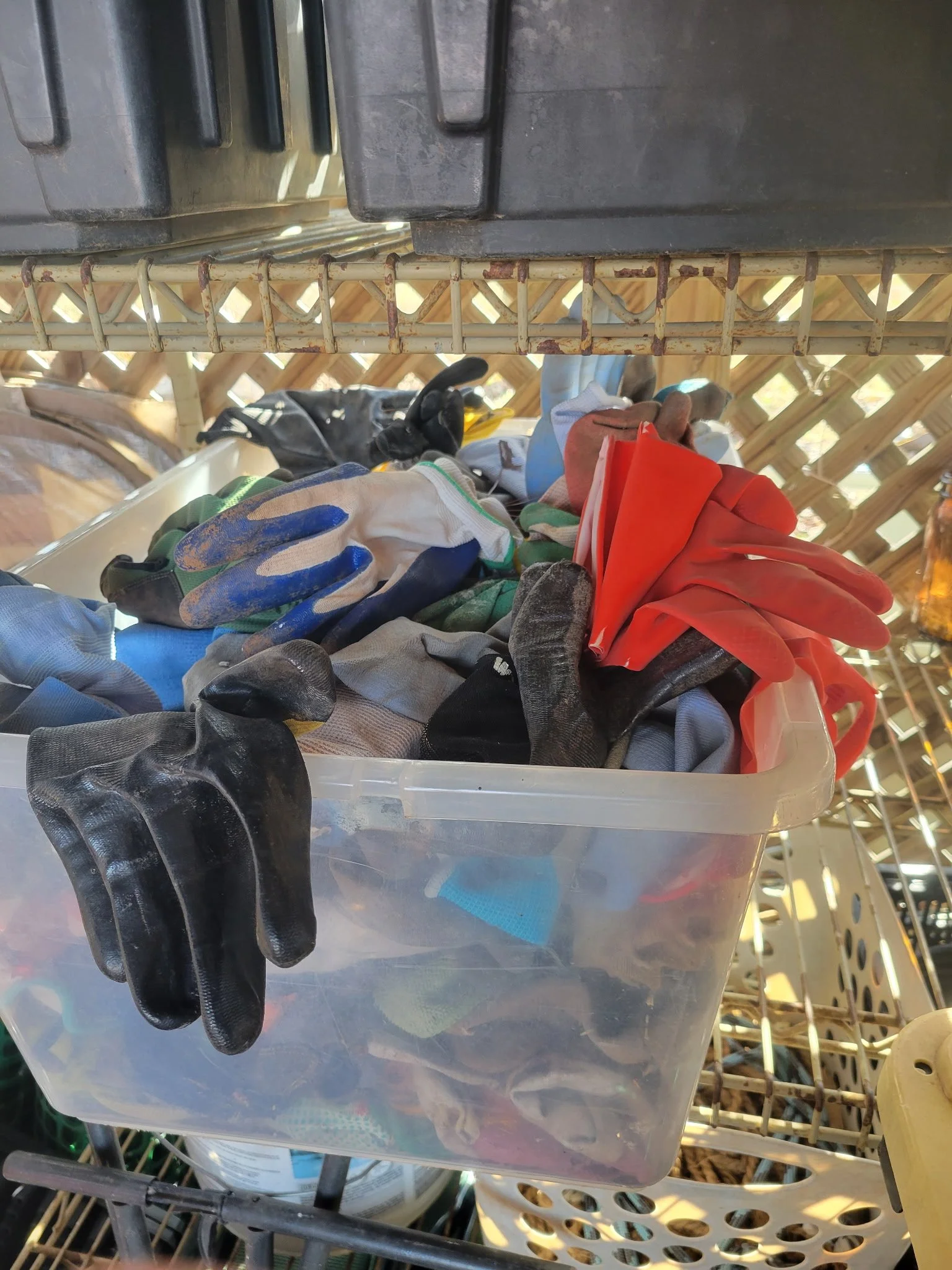
photo by Ethan Roe
The first few times I looked in the glove-box (no, not the glovebox of a car, the literal box where we keep the garden gloves), it was confusing. Our gloves are all tossed in a box after use; they are not in pairs, and some are more comfortable than others. I had to get used to pulling out whatever random work gloves felt okay for that day, rather than looking around to see if I could find two that matched. And not only that, I had to figure out which kinds of gloves I needed for the task I was going to take on.
Work gloves, I found, are good for the more messy or out-in-the-field tasks, like snipping stems directly off the plant or pulling up the roots after a season has concluded. But they’re bulky and feel weird on my hands, albeit not as uncomfortable as getting wet and muddy plant matter on my hands. Still not incredibly comfortable.
For the more precise tasks of processing the flowers, either for bouquets or for their seeds, the lead gardener suggested I try latex gloves. The latex gloves I initially tried were the kind you’d typically see in a hospital or lab; thin and easily torn, as I quickly found out. I could feel the celosia seeds as I collected them, but had to replace those gloves more than once.
Eventually, though, I hit a breakthrough. On the shelf above the box of work gloves was a box of thicker, rubbery purple gloves. Not so thick as to make my hands feel trapped as work gloves do, nor so thin as to tear like regular latex gloves. I fished out the pair on top, which had become the target of a spiderweb, and put them aside. Then I found a suitable pair and began testing them out. They were perfect for seed collecting.
Finding the right box of gloves in the pergola, our tool shed, was not a major thing. In the grand scheme of things, it was quite small.
But previously in a job like this, I would have been stuck at the initial hurdle: the textures are wrong and the gloves are uncomfortable. I would have avoided or gone around the task as much as possible for the sake of the discomfort.

photo by Phoebe Lisle
But I’m expanding my experience here at Legacy Farms and becoming more self-aware on many levels. This was a time where I identified something that was getting in the way of my work and independently identified a solution. I didn’t stay stuck on the problem. Unlike before, where I would have been left frozen by a situation that was not already set up for me, I made the situation work for me.
When I move forward into new spaces and new projects, I will be able to take this growth with me into other aspects of life- to change the circumstances instead of giving up or grumbling through frustration. Great grandma’s boiled gloves aren’t the only way to harvest plants.
———
Thank you for reading! When you support Legacy Farms through donations and floral purchases, you nurture all of our apprentices' work and growth...our gardeners, aspiring photographers and entrepreneurs, and writers like James! Each program we offer and every flower we grow is part of something bigger.
Legacy Farms provides vocational training and meaningful work experience for neurodivergent young adults — building pathways to confidence, independence, and community connection.